The Animals I Still Think About
Some animals stay with us.
Not in the practical ways, of course. They do not follow us from room to room. They do not sleep at the foot of the bed or wait by the door with hopeful eyes. They do not nudge our hands, flick their ears, or make us laugh with some small, particular habit that belongs only to them.
And yet they stay.
They appear at unexpected moments, often when we are doing something ordinary. Driving past a pasture. Opening the refrigerator. Seeing a truck on the highway. Passing the meat section in a grocery store. Watching a video of a rescued cow resting her enormous head in someone’s lap as if she has finally discovered what tenderness is.
For me, these animals are not always ones I have personally known. Some are animals I have read about. Some are animals I have seen in photographs or videos. Some are animals I have only imagined after learning what happens to so many of them behind closed doors.
There are cows I still think about.
Not one cow, exactly, but the many gentle faces I have seen over the years. Their wide eyes. Their heavy heads. The way they seem to carry both innocence and ancient wisdom at once. I think about mother cows calling for calves who have been taken from them. I think about the unfairness of a love that is so real, so biological, so unmistakable, being treated as if it does not matter.
There are pigs I still think about.
Pigs are often described as intelligent, but that word feels too small sometimes. They are curious. Social. Emotional. Mischievous. Capable of joy, fear, comfort, and attachment. I think about how easily we turn living beings into products once we stop looking closely. I think about pigs who never get to feel sunshine on their backs or root in the earth or stretch out in straw beside a friend.
There are chickens I still think about, even though I once barely thought about chickens at all.
That is one of the uncomfortable truths about becoming more aware. You begin to realize how many lives you had been taught not to notice. Chickens are everywhere in our food system and almost nowhere in our compassion. Their suffering is so common that it becomes invisible, and I think that may be the saddest thing of all.
And then there are the animals closer to home.
The dogs and cats who have shared our houses and routines. The ones whose absence rearranges the air. The ones we still expect to see in certain corners. The ones whose names can still catch in our throats years later.
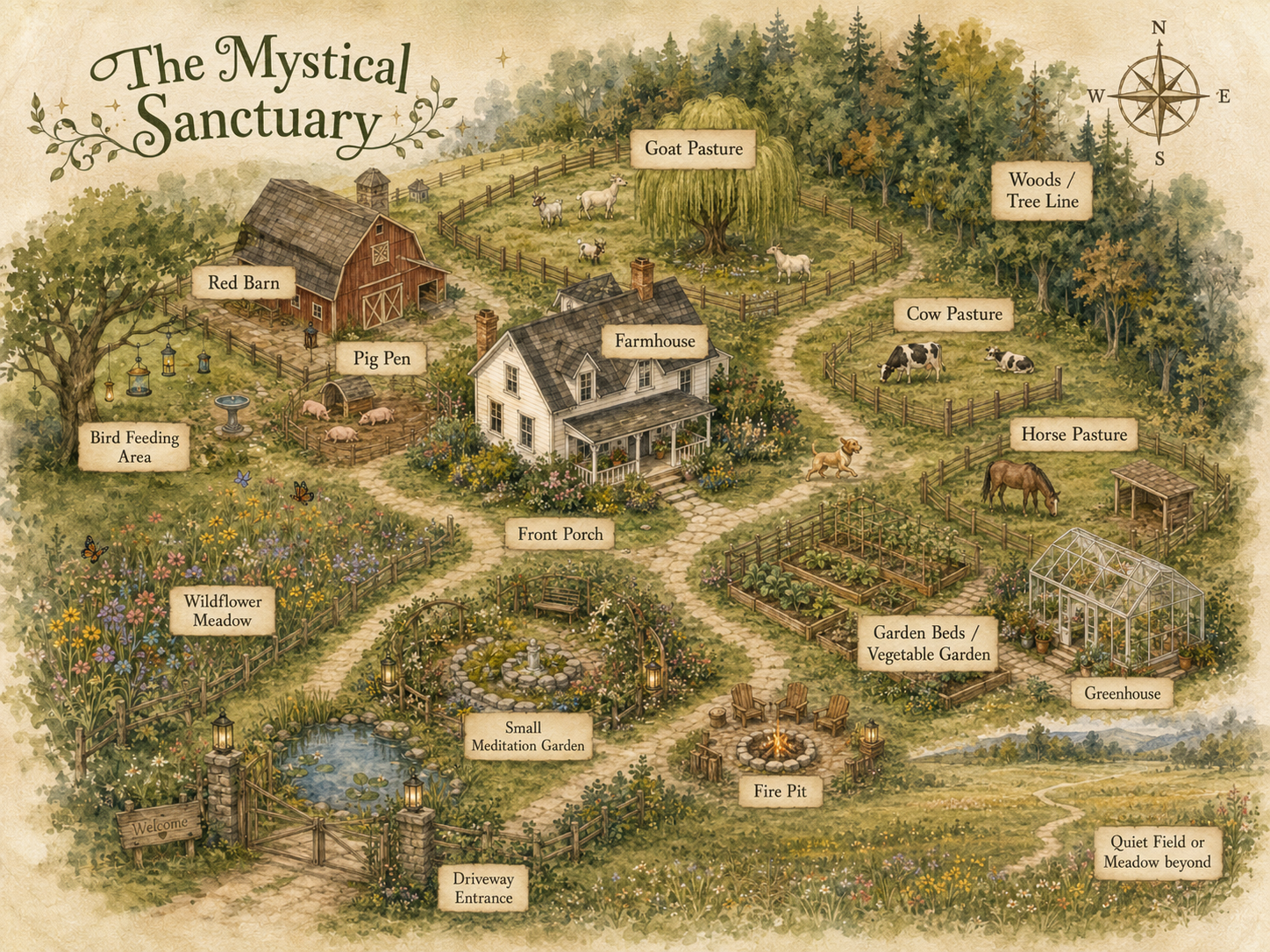
Maybe that is why I created the Sanctuary in The Mystical Sanctuary.
At first, I thought I was simply writing a story about friendship, healing, tarot, and a farmhouse that becomes something more than anyone expected. But the deeper I went, the more I realized I was building a place for the animals I still think about.
A place where the forgotten are remembered.
A place where the injured are not discarded.
A place where the old are not seen as useless.
A place where animals are not valued for what they produce, but for who they are.
In my mind, the Sanctuary has always been more than a setting. It is almost a character itself. I can picture the farmhouse, warm and slightly worn, with the kitchen table where people gather for coffee, conversation, and sometimes a tarot reading that reveals more than anyone expected. I can see the barn, the pasture, the pond, the garden, the willow tree, and the quiet little places where healing happens without announcing itself.
That is why I’ve been thinking about sharing a Sanctuary map or floor plan.
Not because every reader needs to know exactly where the duck pond is or how far the barn sits from the farmhouse, but because maps can be a kind of invitation. They say: Come in. Look around. This place exists, at least here, between us.
And maybe that matters.
We live in a world where it is very easy to feel helpless. The problems are too large. The systems are too entrenched. The suffering is too hidden, too widespread, too painful to take in all at once. Sometimes we look away not because we do not care, but because caring feels like standing in front of an ocean with a teacup.
But stories give us a place to begin.
A sanctuary, even an imaginary one, can remind us what compassion looks like when it is made visible. It looks like a gate opened gently. A bowl filled with clean water. A frightened animal given time. A woman sitting quietly beside a grieving cow. A volunteer repairing a fence. A child learning that pigs have personalities. A reader pausing, maybe for the first time, to wonder about the life behind the meal on a plate.
That pause matters.
I know not everyone will make the same choices. I know people come to these questions from different backgrounds, habits, families, cultures, and comfort levels. I also know that shame rarely changes anyone for the better. But tenderness can. Curiosity can. A story can. A single animal’s face can.
The animals I still think about have changed me.
They have made me softer in some ways and stronger in others. They have made it harder for me to accept certain things just because they are normal. They have made me ask better questions. They have made me pay attention.
And perhaps that is the quiet hope behind the Sanctuary.
Not that it solves everything.
Not that it rescues every animal.
Not that it erases grief, cruelty, or loss.
But that it offers another way of seeing.
A way of seeing animals not as background, not as commodities, not as symbols, not as “less than,” but as beings with their own experience of the world. Beings who feel fear and comfort. Beings who recognize kindness. Beings who want to live.
So yes, I think I will share the map.
I think I will open the gate a little wider and let readers wander the paths, peek into the barn, stand beneath the willow tree, and imagine what it might feel like to live in a world where every vulnerable creature is met with mercy.
Because the animals I still think about deserve that much.
And maybe, in thinking about them together, we create a small sanctuary of our own.